
A few weeks ago, Digett deployed a web application for the Rotary Club of San Antonio. It's called Seva Events — an event management and payment processing system that's already helping recover thousands of dollars a year in revenue that had been slipping through the cracks. The kind of tool that, not long ago, would have required a dedicated developer working for at least a couple of months at minimum, and a traditional agency engagement even longer than that.
We built it in a few weeks.
I don't say that to impress anyone. I say it because the implications are significant, and I think nonprofit leaders in particular need to understand what just happened.
What changed
Sometime in the past six months, AI-powered coding tools crossed a threshold. They went from interesting-but-unreliable to mind-blowing and indispensable. With guidance from an experienced analyst and architect — someone who understands the problem being solved and the code being written — these tools produce clean, production-ready software at a pace that would have seemed absurd less than a year ago.
There's a term for this way of working: agentic engineering. It means the AI handles the execution — writing code, building interfaces, solving technical problems — while a human provides the judgement, the architectural guidance, the overall direction. Think of it as working alongside a tireless, extraordinarily capable developer who still needs someone with the benefit of experience to point them at the right problem and to keep them focused on what it takes to create a solution.
The key word there is experience. AI doesn't replace expertise. It amplifies it.
The old model
For decades, the agency model had a structural advantage: specialization. A team of fifteen — strategist, designer, front-end developer, back-end developer, project manager, QA — could deliver things that smaller shops simply couldn't. The complexity of modern web development demanded that division of labor, and clients paid accordingly.
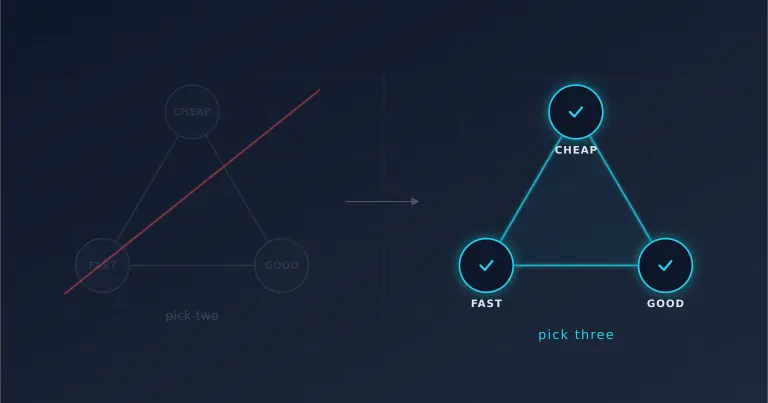
There was even a rule about it. You've probably heard it, as in our day in age it has typically applied to everything: cheap, fast, good — pick two. It's became so accepted that nobody questions it anymore. It's just how things have always worked.
What's different now
Let me be clear about something: I'm not saying that building websites is easy now. Building software is not the same thing as building a solution. Few individuals have the breadth of skills required to diagnose a business problem and then design and build a real solution for it. If we're talking about people who make their living primarily as developers, we're probably talking even fewer.
What has changed is this: the work that web developers have traditionally contributed to a typical website project — the coding, the implementation, the technical build — has become relatively trivial, thanks to AI tools, for anyone who understands the architecture of the web at a meaningful level.
And until this shift, a big chunk of the cost of creating a website could be attributed to that development work. That cost just got slashed.
The expensive part moved. It used to be execution. Now it's judgment — the positioning, the strategy, the diagnosis of what the organization actually needs. That was, in fact, always the the most critical work. It just wasn't where the budget went.
A less onerous process
Here's what changes when development happens at this speed: the process itself compresses. When it takes a developer a month to build something, you need detailed specifications up front, formal handoffs between teams, and structured review cycles — because the cost of building the wrong thing is, well, a month. When that same work takes a few days, with an impressive draft release ready in just a day or two, you can build it, look at it, and adjust. The scaffolding that the old pace required — the specs, the handoffs, the layers of review — shrinks, because the cost of iteration just dropped to almost nothing.
That's how smaller teams deliver faster. Not by skipping steps, but because the speed of execution changes which steps you need.
A better website
And here's the part that surprises a lot of people, and I just can't get over it myself: the output is also better.
In the hands of a skilled architect, AI produces a website that scores higher in technical performance, includes more of the features that help your site compete in search — things like structured data that most developers skip because they're tedious to implement — adds visual polish like subtle animations that would have blown the budget before, and ships with fewer bugs. Not because AI is magic (or is it?), but because it doesn't get tired, doesn't cut corners at 4pm on a Friday, and doesn't skip the boring stuff. Oh yeah, and it's really smart.
So it's not just faster and cheaper. The thing you get at the end is genuinely better than what the old model produced at five times the cost and timeline.
The old rule — cheap, fast, good: pick two — just broke.
Why this matters for nonprofits
Nonprofits have always operated under tighter budget constraints than most organizations. You've been told that a good website costs $75,000 to $150,000 and takes three to six months. You've been told that's just what it costs.
For a long time, that was true. It's not true anymore.
The organizations that recognize this shift early will have a meaningful advantage — not just in dollars saved, but in speed to market, in the quality of what gets built, and in the ability to iterate and improve rather than being locked into a deliverable that's half-dated by the time it launches.
Does this mean you should try to build it yourself? Probably not. Few nonprofits have that internal capability, and even with AI tools, you still need to work with someone who understands web architecture and digital strategy at a deep level. But it does mean you should be asking harder questions about who you hire and whether all those layers are actually serving you — or whether you're paying for a model that made sense five years ago and doesn't anymore.
A case in point
The Rotary Club of San Antonio needed a system to manage event registrations and process payments. Revenue was falling through the cracks — money the club depends on to fund its service work in the community. A traditional agency would have scoped this as a multi-month engagement involving multiple specialists, a series of handoffs, and a budget to match.
Instead, we built Seva Events with a small team, in a few weeks, with direct communication between the people who understood the problem and those who understood the tools to build the solution. It's a work in progress — good software usually is — but it's already making a tangible difference. Thousands of dollars a month that were being lost are now being captured.
That's not a story about AI replacing people. It's a story about AI enabling a small team to move fast and solve a real problem for an organization that couldn't have justified the old price tag.
A word about the future
Will AI eventually replace the human judgment layer, too? I honestly don't know. But here's what I do know: if AI gets good enough to handle positioning, strategy, messaging, and taste without human guidance, we'll all have much bigger things to figure out than who's building websites.
For now, the human layer — the experience, the judgment, the ability to understand what a client wants and needs, and what their audience wants and needs — is what matters. AI just made it matter more, not less.
The window
The market hasn't fully caught up yet. Some agencies are still staffing—and pricing—like it's 2023. Some nonprofits are still buying like it's 2023.
That gap — between what's possible and what's common — is your window.
Find a partner who's working this way. Ask them what they've built recently, how long it took, and what it cost. Then compare that to your last agency engagement. The numbers will speak for themselves.
I hope to help as many mission-driven organizations take advantage of the window as possible. Contact me and let's have coffee.