
If you run a nonprofit, I probably don't need to tell you that things are bad. But let me put some numbers to what you're feeling.
One-third of U.S. nonprofit service providers experienced disruption in government funding in the first half of 2025.[1] Urban Institute, "How Government Funding Disruptions Affected Nonprofits in Early 2025" The median loss was $150,000.[2] Chronicle of Philanthropy, "A Third of U.S. Nonprofits That Serve Communities Lost Government Funding in Early 2025" Fifty-two percent of nonprofits now have three months or less of cash on hand — up from 39% just four years ago.[3] Nonprofit Finance Fund, 2025 State of the Nonprofit Sector Survey Thirty-six percent ended their most recent fiscal year with an operating deficit, the highest rate in a decade.[3] Nonprofit Finance Fund, 2025 State of the Nonprofit Sector Survey Then came the longest government shutdown in U.S. history — 43 days, October through mid-November — and nonprofits entered it already weakened.[4] The Nonprofit Alliance, "The Government Shutdown's Impact Will Continue for Nonprofits"
Meanwhile, demand for your services is rising. Sixty-eight to eighty-five percent of nonprofits expect that demand to increase.[1] Urban Institute, "How Government Funding Disruptions Affected Nonprofits in Early 2025" But only 31% are actually expanding how many people they serve.[5] Independent Sector, "New Report Shows Nonprofits Are Being Squeezed"
You're being asked to do more with less. You've heard that phrase so many times it's lost its meaning. But the math behind it has never been this stark.
The squeeze
Here's the part that doesn't get talked about enough: the people doing this work are breaking.
Ninety-five percent of nonprofit leaders express concern about staff burnout.[6] Center for Effective Philanthropy, "Nonprofit Leaders Cite Burnout as a Top Concern" Two-thirds of nonprofit employees are looking for new jobs or plan to within a year.[7] Candid, "The People Behind Nonprofit Impact" A third of CEOs are planning to leave within two years.[8] Kittleman, "Nonprofit CEO Departures at Record Levels in 2025" And 22% of nonprofit workers — the people you're counting on to serve your community — can't afford basic necessities like housing, food, and healthcare.[9] Independent Sector, "Research Finds 22% of Nonprofit Workers Experience Financial Hardship"
The top reason people give for leaving? Too much responsibility and not enough support.[7] Candid, "The People Behind Nonprofit Impact"
This is not a staffing problem. This is a structural crisis. The sector is losing institutional knowledge, leadership capacity, and operational continuity all at once. And it's happening at exactly the moment when the communities you serve need you most.
The 12% problem
Now here's where I want to shift from the problems you already know about to one you might not be thinking about — but should be.
Seventy-four percent of nonprofit leaders say digital transformation is a "need-to-have" or "must-have."[10] Salesforce, "Nonprofit Statistics & Trends Report" / NonProfit PRO, "Just 12% of Nonprofits Are Digitally Mature" That's nearly three out of four. The sector overwhelmingly recognizes that technology is critical.
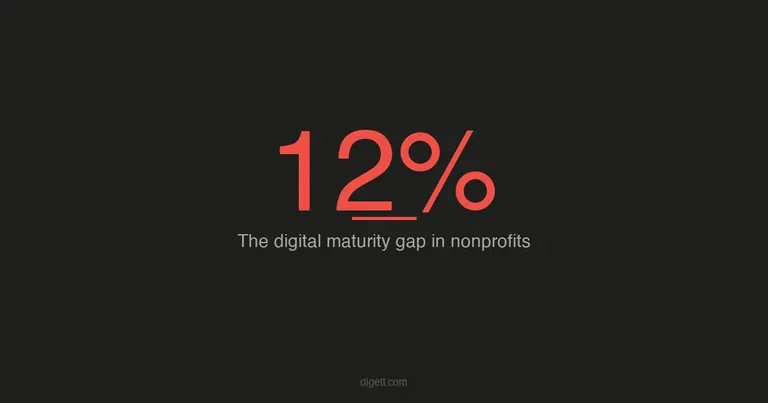
But only 12% of nonprofits have actually achieved what researchers call "digital maturity."[10] Salesforce, "Nonprofit Statistics & Trends Report" / NonProfit PRO, "Just 12% of Nonprofits Are Digitally Mature"
That's a 62-point gap between knowing and doing. And it matters, because the data shows that digitally mature nonprofits are four times more likely to achieve their mission goals — regardless of revenue, headcount, or geography.[10] Salesforce, "Nonprofit Statistics & Trends Report" / NonProfit PRO, "Just 12% of Nonprofits Are Digitally Mature"
Four times.
Let that sit for a moment. In a sector where 81% of organizations struggled to raise enough funds to cover costs last year,[3] Nonprofit Finance Fund, 2025 State of the Nonprofit Sector Survey where 61% say current conditions pose moderate to significant risk to their continued operations,[5] Independent Sector, "New Report Shows Nonprofits Are Being Squeezed" the organizations that have figured out their digital infrastructure are four times more likely to succeed at the thing they exist to do.
"Digitally immature" actually looks like
If 12% feels abstract, here's what it looks like in practice.
Seventy-two percent of nonprofits take between two and seven days to pull together basic operational or financial data.[11] Redpath Consulting, "From Fragmented to Focused: How Nonprofits Can Break Down Data Silos" When a funder asks for evidence of impact, staff spend a week assembling what should take an hour — reconciling fragments from five different systems, none of which talk to each other.
Forty-five percent say their top barrier to innovation is dependence on legacy applications — systems from the 2000s or earlier that they can't afford to replace and can't afford to keep running.[12] Grant Thornton, "Tech as a Mission Enabler for Nonprofits" Sixty percent of nonprofit professionals don't use data to aid decision-making at all.[13] DonorSearch, "Nonprofit Impact Matters: Analytics & Data Strategy" And 43% of nonprofits rely on just one or two staff members for all IT and technology decisions.[14] Sage, "2025 Nonprofit Technology Impact Report"
Then there's the website — which for many nonprofits is the single most important tool for fundraising, storytelling, and public credibility. Only 1% of nonprofit websites received a top performance score on mobile devices. Eighty percent received a failing mark.[15] RKD Group, "Nonprofit Website Performance Report" This, in a world where 60% of all charitable donations are now made online[16] Nonprofit Tech for Good, "Online Fundraising Statistics" and where donors increasingly judge an organization's legitimacy by its digital presence.
Your website is your front door. For 80% of nonprofits, that front door is broken on the device most people use to open it.
Why this keeps not getting fixed
It's tempting to say "we just don't have the budget." And that's partly true. But budget isn't the whole story.
The deeper issue is that digital transformation has always been presented to nonprofits as a massive, expensive, disruptive undertaking — a six-figure project that requires months of planning, a team of consultants, and a painful migration away from systems your staff have spent years learning to work around. When you're running on three months of cash and your staff is already burned out, that pitch is a non-starter.
So nothing changes. The legacy systems stay. The data stays siloed. The website stays slow. And the gap between the 12% and everyone else keeps widening.
But here's what I want you to hear: the economics of fixing this just changed. The cost and complexity of building a modern, high-performing digital presence has dropped dramatically in the past year — thanks to advances in AI-powered development that have fundamentally altered what's possible and at what price. What used to require a large agency, a six-figure budget, and six months of work can now be delivered faster, better, and at a fraction of the cost.[17] See: "Cheap, Fast, Good: Pick Three"
The excuse that digital transformation is too expensive to prioritize? It's evaporating. Fast.
The window
I understand the instinct to put digital investment on the back burner when you're fighting to keep the lights on. But consider this: the nonprofits that weathered the 2025 funding crisis best were the ones that could pivot — the ones that could tell their story effectively online, reach new donors quickly, demonstrate impact with data, and operate efficiently with lean teams. In other words, the 12%.
The other 88% are still trying to pull together a funder report in under a week.
There is a window right now — a brief period where the tools have gotten dramatically better but the sector hasn't caught up yet. The nonprofits that move through that window will emerge with infrastructure that makes everything else easier: fundraising, reporting, storytelling, hiring, retention. The ones that don't will keep spending more time on administrative overhead than on the mission that brought them to this work in the first place.
Your community can't wait for you to get around to it. And honestly, at the rate things are changing, neither can you.